
on being in community
one step at a time

Hey friends,
I found this one in my drafts and thought, before I change things up on this page, I’d share it with you. Thank you for being here.
With love & gratitude,
SC xo
The dominant culture in this society excels at lots of things like, exploitation, hoarding, theft, oppression… but being in relationship, reciprocity and community aren’t any of them. Yet, we want to be a part of something. We need each other. We’ve got an instinctual urge to belong to the group. We’re desperate to do what’s expected of us for fear of rejection. But we’ve also been conditioned to believe that we must do life independently, or else we’ll not be seen as capable enough. It’s like a tightrope we balance on, made all the more challenging by our proximity to power and whether we’re considered worthy of belonging. Or not.
We want to belong, but will settle for fit in.
We don’t think about how we can relate to each other, see our role in supporting others while also honouring our capacity. We don’t see how we can be of service, where reciprocity isn’t an act of give and take, or earning the help you need, but a way that can benefit us as a whole. We’re not conditioned to normalise that kind of community care.
Now, I’ve been thinking about this for a long time because something about everyone (I’ll admit it, mostly white people) talking lately about “being in community” didn’t sit well with me. The whole thing about recognising the need for community was great and all, because there is no way that we’re getting through this hellscape that is what we’re doing to ourselves, each other and the Earth, on our own. But do they even know what it actually means to be “in community” or how to “be” in one? My experience of being “in community” with white people, led to the kind of experiences that introduced me to therapy.
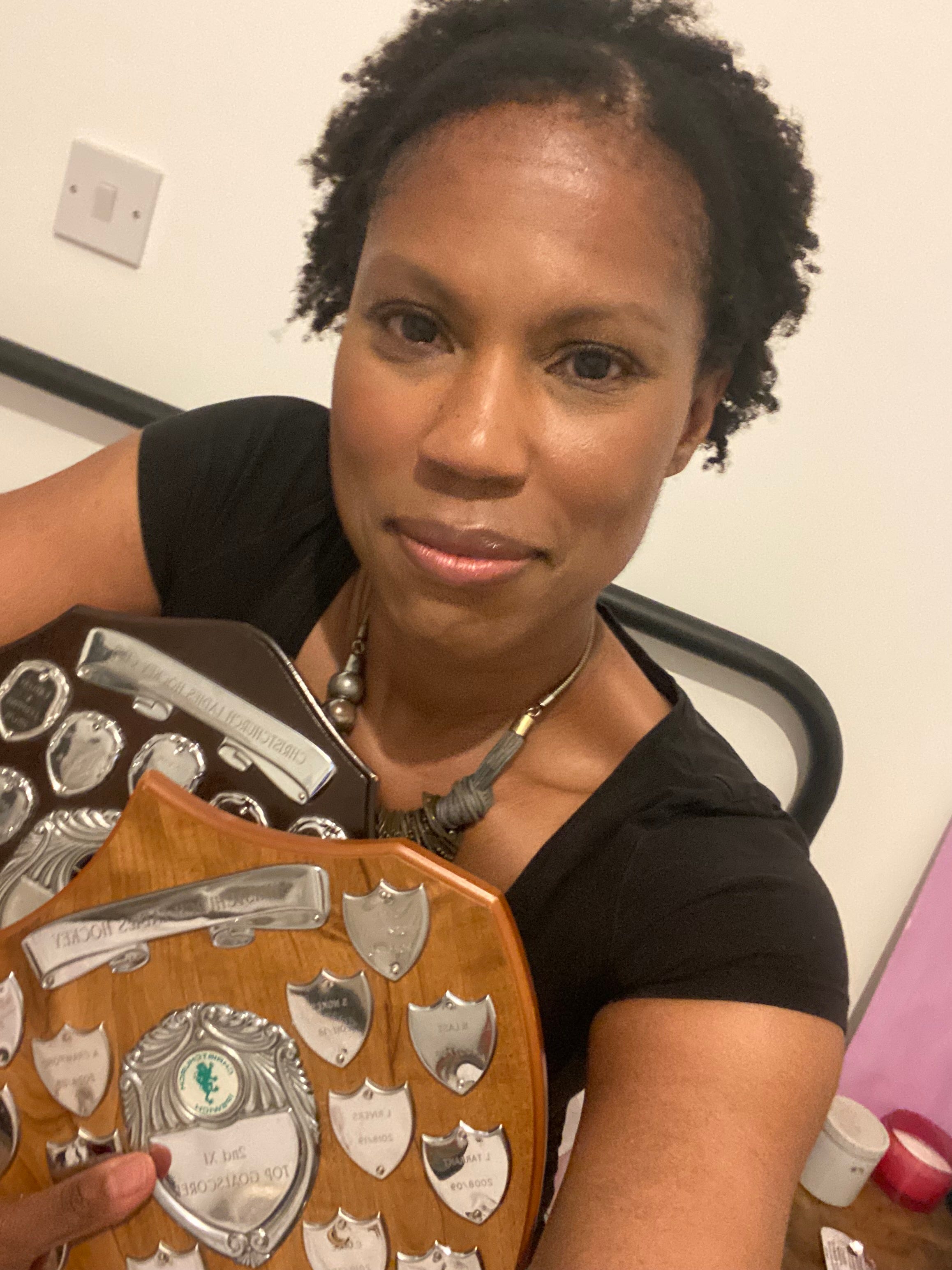
As a transracial adoptee, I’ve spent my life being “in community” with white people. But it never felt like white people were actually “in community” with me. If I made a mistake, I quickly became the mistake, being made an example of and distanced from. I was celebrated when it benefited them, but exiled and ignored when I didn’t. I was disposable when I wasn’t of use, especially if I wasn’t as likeable as I was told I should be (likeable reads: doing what I was told, being the cool Black girl, being their Black mammy or personal therapist). If I couldn’t fit the expected mould, there was no question about whether I’d be pushed out. The only question was when.
And I had a lot to learn about how I could be myself and stay safely in community too.
Pat, the radical therapist on Instagram, wrote this post back in February 2025 to ask us all to reflect on an important question. Can white people build deep, authentic friendships with people of the global majority?
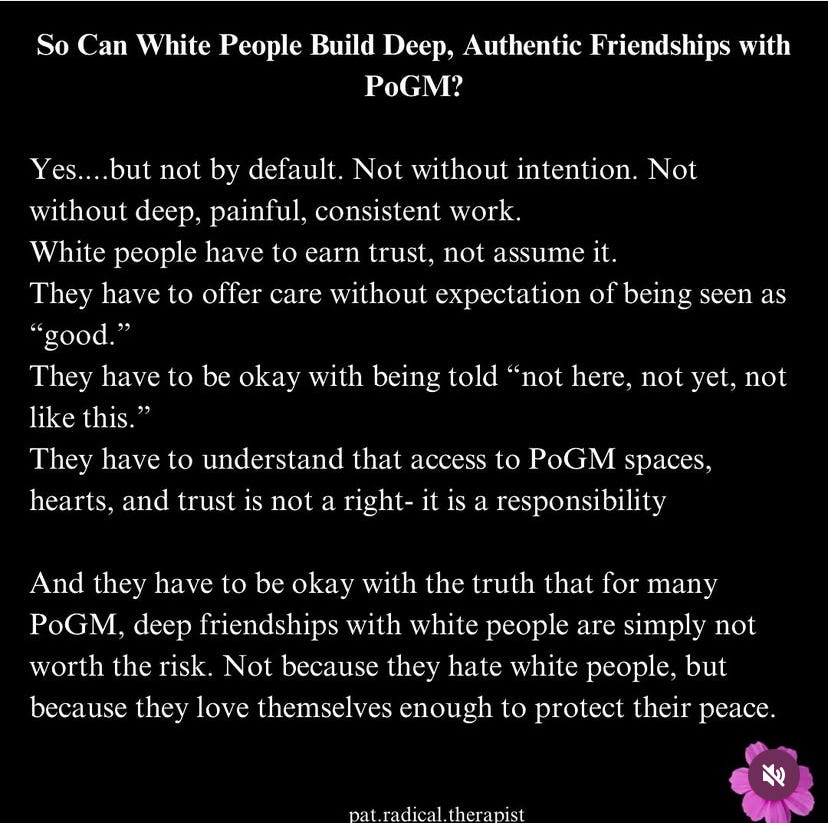
The short answer is yes, but not without a LOT of intentional, consistent, deep, uncomfortable inner work. I shared the answer slide below, but I encourage you to read the whole post because the accuracy of sharing her experiences was healing for me. I wasn’t alone in what I experienced. I don’t doubt that some white people will find it quite uncomfortable to read, though. Feel free to ground yourself, then reflect on her words afterwards.
I’ve always blamed this on the individualism of the dominant culture. It’s seen as a goal to grow up to be independent and/or self-made. Even the model minority myth is based on the idea of a “good minority group” being successful without any “special, outside help”. We learn that to be worthy, good enough and fit this culture, we must be productive and successful by accomplishing this on our own.
But, being from a collective culture carries its own struggles with community building too, especially when impacted by the dominant culture. We can’t build effective communities when we’re expected to center some people over others, not speak up or take up space, either. Or by ensuring that everything we do must be for the collective, even if it means becoming something we’re not.
In collectivist cultures, the impact of individualism is becoming more visible and with it, changes in how we “build community”. It’s not about individuals being themselves while deciding how best to be of service to each other. Now, it’s as if they must either be forever sworn to the collective or demand total independence from it. There’s no in-between. We’ve all been injected with a poison (the dominant culture), our bodies haven’t learned how to get rid of yet.
I first heard the now Emmy award winner, Richie Reseda of question.culture speak on Prentis Hemphill’s Becoming the People podcast. He does a lot of work within the (carceral) system and his focus is on how we can move towards being in community (which also includes how we can police ourselves). This podcast episode was one of my first forays into what “being in community” could look like and the inner work we need to do to get us there. Some great parts of this episode are how he talks about toxic masculinity and the impact of shame. And this matters when we talk about community.
The more that we see ourselves through the lens of shame, the harder it is to humanise ourselves and see that we can belong, including those parts of us that society tells us are bad or wrong. The truth is, being in community means we need to be vulnerable.
We need to be willing to see ourselves in the wholeness of who we are, especially those parts still sensitive and raw from being hidden for so long. We must gently bring these unseen parts of us into the light. When we start to rehumanise ourselves, we finally begin to see the humanity in others, which cultivates reconnection - part of what it takes to be in community.
But the impact of the dominant culture has us all deeply wounded, disconnected from ourselves and, because of that, each other. We struggle to do things like set our boundaries with ourselves, let alone others. We can barely ask others for help without accompanying fears of what people will think of us when we do. We hold so much shame about who we are, which impacts how we relate to others. Not to mention the dominant culture has ensured that we learned that being ourselves would never be enough. The vulnerability it takes to be seen as ourselves to connect with others feels too risky. We fear punishment and rejection above all else.
So it’s no surprise that I find it an unsettling that suddenly, we can “be in community”, because we finally see we’re not getting through any of this without each other?!?
Make that make sense.
It doesn’t.
But the dominant culture moves like this. It acknowledges there’s a problem (that it’s caused, of course, but is in denial about that part), and it urgently wants to “solve it”. Solve it, meaning, make it go away so it doesn’t have to face its discomfort and think of its part in it. Only, this doesn’t solve a thing. It simply finds the quickest way to make things appear “better.” Much like using a plaster to cover a gaping wound while never acknowledging the fact that it’s infected.
And let me tell you, that wound is so infected, it needs surgery immediately.
For this dumpster fire of a world we’re in, we need each other; we need connection. We need community. There’s no question about any of that. But to be in community is an also skill we need to develop. I’ve always thought that skill was learning interdependence. And I’m not the only one.
If you do one thing for yourself today, follow Christabel Mintah-Galloway. They’re a Black, queer person whose work on relationship building and being in community is giving me life! And it’s not only because they’re writing about things I’ve been thinking about over the last few years either, but because they actively do the work to live in an interdependent way and want to help others do the same.
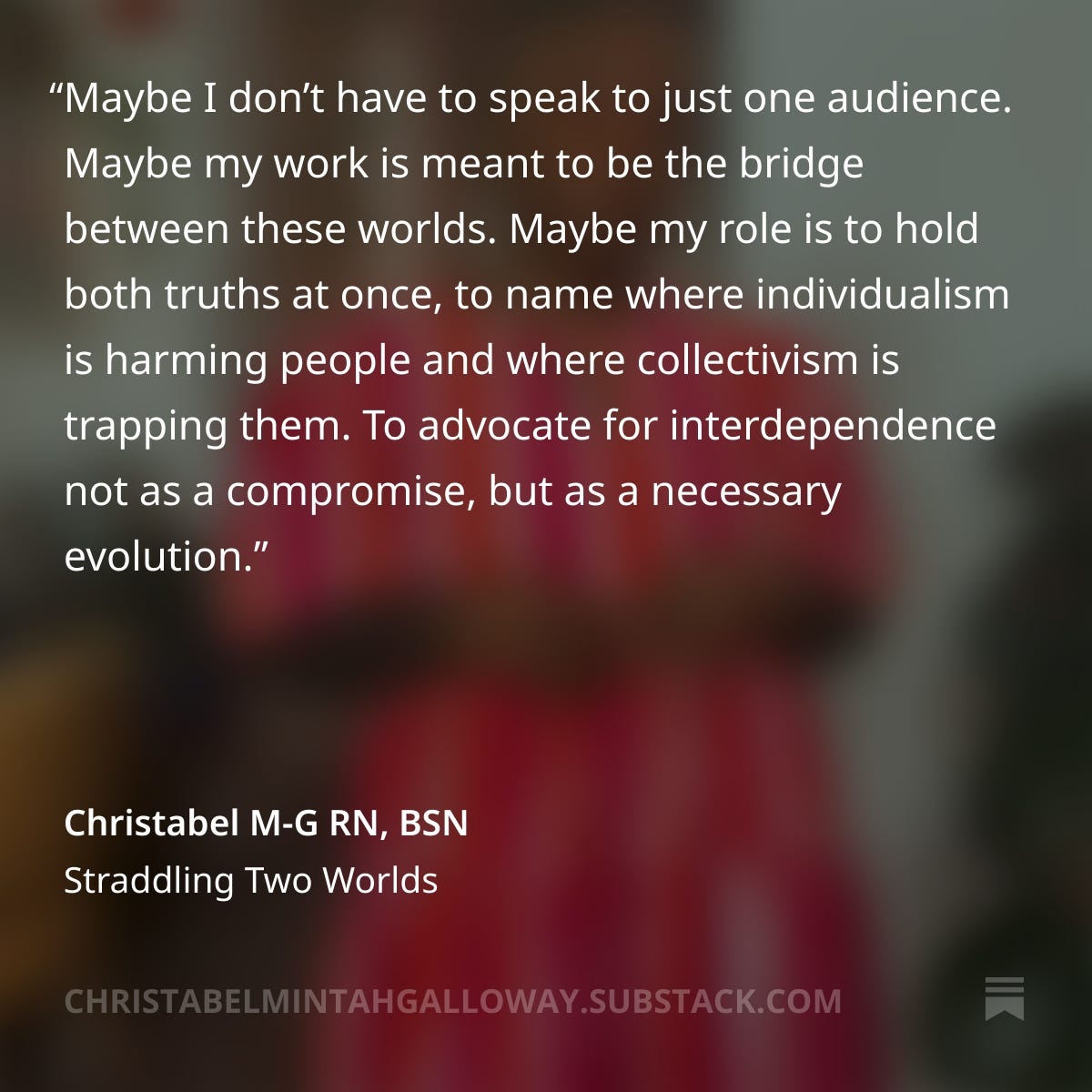
They see the ways that individualism and collectivism, as we experience them, aren’t the answers for creating the kind of communities we need to thrive. Christabel is guiding us towards something different, because she is learning this work too.
Y’all know how I love that kind of thing.
From what I’ve been reading and been intrigued with lately, I don’t think I’m far wrong. I just don’t believe that “being in community” with others is completely feasible without intentional, on-going inner work on ourselves and developing new skills to support our ability to relate with each other. These relational skills include but are not limited to: when we get on well, when we don’t get on well but we have to, when we rupture, how we repair and what accountability looks like.
If finding community is the easy part (or even if it’s a challenge for some of us), being in one can be that much harder. But it’s also much more rewarding. We aren’t meant to do this life alone. Nor are we meant to do life with others, but only when it suits us and completely on our terms. Building community is a journey and a practice.
It’s moving towards interdependence.
Reflect on these:
Interdependence is described here as a "journey and a practice" rather than a destination. What is one small, daily practice that helps you move away from either total independence or being swallowed by the collective? What does the "in-between" look like for you?
If you were to step fully into your own "wholeness" and humanise yourself completely, what kind of community care would you feel entitled to receive? What kind of service would you feel energized to give?
Support my work by becoming a paid subscriber or buying one of my books: It’s Never Just ADHD or my new embodiment colouring journal Keystone (or as a PDF). Thank you!
Great article!
Note 1: to Sandra Coral: https://www.instagram.com/pat.radical.therapist/ is a private profile, so many of us won’t be able to read that thread.
Note 1: This is a comment for the “reading circle” that forms below an article, where we have the privilege of the author also being in the circle. It is not meant to be seen as a non-racialized person replying to a racialized person, and I’m actually writing this primarily for fellow non-racialized people. I’ve noticed some confusions about how different people use substack comments and notes in discussions.
I started writing a comment and it became too long for that format, so I made it into a Substack article.
https://r.flora.ca/p/can-white-people-be-in-community